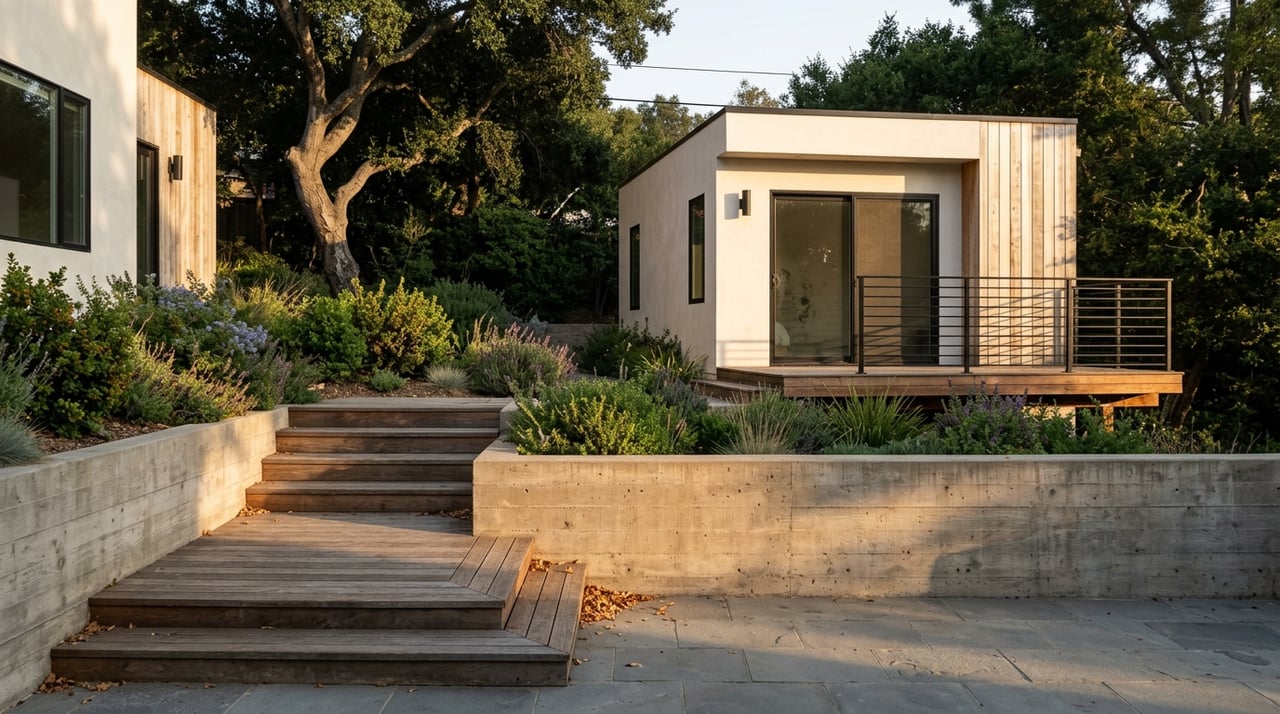
If you own a home in Mill Valley, an ADU can look like a smart way to create flexibility and possibly add income. You may be thinking about space for extended family, a longer-term rental, or how to make your property more appealing in a high-value market. The key is knowing what Mill Valley allows, what hillside conditions can do to your budget, and how rental rules shape the opportunity. Let’s dive in.
What an ADU means in Mill Valley
In Mill Valley, an accessory dwelling unit, or ADU, is a secondary home on the same parcel as an existing or proposed primary residence. The City also recognizes junior ADUs, or JADUs, which are smaller units created within the walls of the main home.
For many homeowners, the practical takeaway is simple. Mill Valley does allow ADUs, but the right approach depends on the type of unit, the size of the lot, and the physical conditions of the site. On single-family lots, the City says you can generally have one detached ADU, one conversion ADU, and one JADU, subject to the applicable rules.
ADU vs. JADU
A standard ADU usually offers more flexibility if your goal is rental income or a more independent living space. It can be detached, attached, or created through a conversion of existing space.
A JADU is more limited. Mill Valley says it must be built within the existing walls of the primary dwelling, can be up to 500 square feet, uses an efficiency kitchen, and may share or have a separate bathroom. It also carries an owner-occupancy requirement unless an exception applies, which makes it less flexible for a pure rental strategy.
Mill Valley permit paths to know
Not every ADU project follows the same review path. Some are relatively straightforward, while others trigger more review because of design, grading, tree impacts, or site complexity.
Mill Valley says building-permit-only review can apply to several common project types, including JADU conversions, ADU conversions, detached ADUs up to 800 square feet and 16 feet tall with at least 4-foot side and rear setbacks, and attached ADUs up to 800 square feet and 25 feet tall with the same setbacks.
If your project does not fit those standards, it can still move forward through a ministerial ADU permit process. The City says that process is reviewed within 60 days after a complete application is submitted.
When extra review may apply
Some properties need a deeper look before plans are approved. Mill Valley notes that additional discretionary review can be triggered by tree removal, larger remodels or additions, detached ADUs above garages, or exceptions from objective standards.
The City also says projects involving multifamily housing or design review must have an approved site-development planning file. In practical terms, this means your timeline and design strategy should be shaped by the property itself, not just by the unit you want to build.
Hillside lots can change everything
In Mill Valley, hillside conditions are often the biggest factor separating a simple ADU project from a complicated one. A flat lot with an interior conversion is very different from a detached unit on a steep site.
The City’s hillside design guidance encourages new buildings and accessory structures to step with the terrain, minimize cut-and-fill and offhaul, and respect existing drainage patterns and vegetation. The City also advises owners to account for grading, crane access, fire-zone limits, flood-zone constraints, and tree-removal issues before settling on a design.
Why hillside ADUs cost more
A Marin-focused ADU resource says costs can range from about $30,000 for a simple interior conversion JADU to $400,000 or more for a large detached ADU with high-end finishes on a hillside lot. The same source gives a rough placeholder of about $450 per square foot for construction and related costs such as design and fees, while noting that actual budgets vary widely.
That wide range matters in Mill Valley. On a sloped parcel, the site work can drive the budget as much as the structure itself. Grading, retaining, staging equipment, and possible crane access can all add cost before you even get to finishes.
Lower-cost paths to consider
If your goal is to add living space with a more controlled budget, a conversion ADU or JADU is often the easier place to start. Reusing existing structure can reduce site work and avoid some of the complexity that comes with detached new construction.
Mill Valley also offers a pre-approved detached ADU structure-only program. The City says pre-approved plans can help streamline review and may reduce time and cost, but they apply only to detached new-construction ADUs and cannot be freely revised.
Parking and layout rules that affect design
Parking is another issue that can shape the layout of an ADU project. Mill Valley’s handout says one parking space per ADU is typical, but there are important exceptions.
Parking may be waived for certain building-permit-only ADUs, conversion ADUs, units within one-half mile of transit, and units in the H-O Historic Overlay District. The City also says that if parking is removed during a garage, carport, or surface parking conversion, it does not have to be replaced for the main residence.
For homeowners, that can open up options. A former garage or underused interior area may be more viable than you think, especially if parking replacement is not required.
Rental potential in Mill Valley
If you are evaluating an ADU as an income-producing asset, Mill Valley offers real opportunity, but the rules matter. The City requires a recorded deed restriction and says the ADU cannot be sold separately from the primary residence.
The City also says ADUs must be rented for at least 30 consecutive days. That means they are suitable for long-term or mid-term tenancy, but not for short-term rental use.
What current rent levels suggest
Public market trackers place Mill Valley rent in the high $3,000s per month. Zillow reports average rent at about $3,800, while Realtor.com lists a median rent of about $3,950.
Using that data as a rough frame, an ADU in Mill Valley may be able to support gross annual rent in the mid-$40,000s before vacancy, maintenance, taxes, insurance, and financing costs. That is not a guarantee, but it gives you a practical benchmark when weighing build cost against likely income potential.
Best use cases for ADUs
Marin County’s ADU materials describe ADUs as useful for generating rental income, housing caregivers or loved ones, and increasing property value. In Mill Valley, that flexibility is a major part of the appeal.
A well-designed ADU can support several goals at once:
- Longer-term rental income
- Space for multigenerational living
- Housing for caregivers or guests
- Better function for a changing household
- Added appeal when it is time to sell
ADUs and resale appeal
Mill Valley is a high-value, fast-moving market. Zillow places the average Mill Valley home value at about $2.07 million and says homes go pending in around 12 days.
In that kind of market, added livable space can matter. Not every buyer will value an ADU the same way, but many will see it as a useful feature that adds flexibility to the property.
Value is about flexibility, not hype
The strongest case for an ADU is usually not that it will automatically pay for itself. The better argument is that in a supply-constrained market, a functional and well-sited ADU can broaden the property’s appeal.
Statewide evidence points in that direction. The Federal Housing Finance Agency found that California properties with ADUs saw stronger median appraised value growth than comparable properties without ADUs from 2013 to 2023. While that is not Mill Valley-specific proof, it supports the idea that ADUs can enhance resale appeal and appraised value in California markets.
How to think about an ADU before you buy or sell
If you already own in Mill Valley, the first question is not just whether you can build an ADU. It is whether your lot, layout, and long-term goals support the right kind of ADU.
If you are buying, it helps to look beyond the main house. A property with garage conversion potential, existing lower-level space, or a feasible detached placement may offer hidden upside that is easy to miss without local guidance.
If you are selling, an existing ADU or a clearly supportable ADU pathway can become part of the property story. In a market like Mill Valley, buyers often respond to smart flexibility, especially when the space is well designed and the use case is easy to understand.
For homeowners and buyers alike, the best ADU decisions usually sit at the intersection of zoning, site conditions, design, and market positioning. That is where local knowledge matters most.
If you are weighing an ADU project, evaluating a property’s rental potential, or preparing a Mill Valley home for sale, working with a local advisor who understands design, redevelopment, and buyer demand can help you make a more strategic move. Reach out to Daniel M. Nebenzahl for thoughtful guidance tailored to your property and goals.
FAQs
What is the difference between an ADU and a JADU in Mill Valley?
- An ADU is a secondary home on the same parcel as the primary residence, while a JADU is a smaller unit created within the existing walls of the main home and has stricter size and occupancy rules.
Can you use a Mill Valley ADU as a short-term rental?
- No. Mill Valley says ADUs must be rented for at least 30 consecutive days, so they are intended for long-term or mid-term occupancy rather than short-term rental use.
How much does it cost to build an ADU in Mill Valley?
- Costs vary widely by type and site, with a Marin-focused resource estimating roughly $30,000 for a simple interior conversion JADU and $400,000 or more for a large detached hillside ADU, with a rough placeholder of about $450 per square foot.
Do hillside lots make Mill Valley ADUs harder to build?
- Yes. Hillside sites can add complexity related to grading, drainage, crane access, fire-zone limits, flood-zone constraints, and tree-removal issues, which can increase both review time and project cost.
Does an ADU add value to a Mill Valley property?
- An ADU can improve flexibility, rental potential, and buyer appeal, and statewide California data suggests properties with ADUs have seen stronger appraised value growth than comparable properties without them.
Can parking requirements affect an ADU project in Mill Valley?
- Yes. One parking space per ADU is typical, but Mill Valley waives parking in certain cases, including some conversion ADUs, some building-permit-only ADUs, units near transit, and units in the H-O Historic Overlay District.