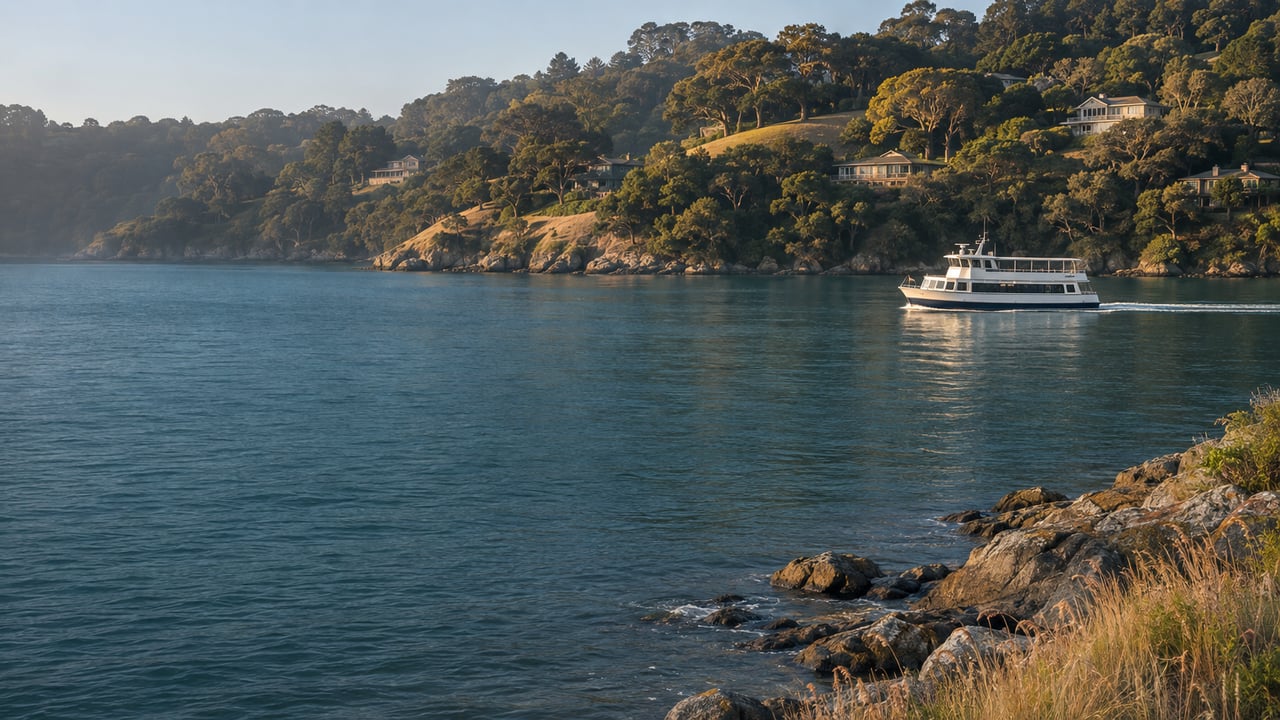
The first Golden Gate Ferry of a weekday morning leaves the landing at the foot of Tiburon Boulevard at 6:50 a.m., bound for the San Francisco Ferry Building. On the standard timetable effective April 13, 2026, two more morning boats follow it, at 8:10 and 9:35. After that, the next departure is 11:50.
If you are weighing a move to Tiburon with a job in the city, that short list is your commute. Tiburon's ferry is a fixed set of sailings. It does not run at a steady frequency, and the fleet behind it is old enough that a single engine failure this fall changed the weekday schedule across Marin. So when you compare houses here, how a home handles a missed or canceled boat counts for more than the 30-minute crossing does. Three things decide that: how far the house is from the landing, how your workday ends, and where your car goes.
Six boats out, seven back
The standard weekday timetable has six departures from Tiburon to San Francisco: 6:50, 8:10 and 9:35 a.m., then 11:50 a.m., 1:15 p.m. and 4:30 p.m. Seven boats come back from San Francisco. The ones that matter after work leave the Ferry Building at 3:50, 5:35 and 7:15 p.m.
Most crossings are scheduled at about 30 minutes. A few run 50 minutes, and the 4:30 p.m. boat out of Tiburon takes 55. The current Golden Gate Ferry fare page lists the adult Clipper fare at $8.50 one way. Since December 10, 2025, contactless bank cards have been accepted at that same fare. Fares for trips that start in Tiburon are collected when riders get off in San Francisco.
More people are riding the route. Golden Gate Ferry counted 141,517 Tiburon riders in fiscal year 2025, which ended June 30, 2025, up from 129,970 the year before.
Read the timetable the way a commuter lives it and the gaps are what matter. If you miss the 8:10, the next boat is at 9:35. If you stay past the 5:35 home, the next one is at 7:15. And because the last boat from Tiburon to the city leaves at 4:30 p.m., any evening plan in San Francisco that starts from the peninsula means a drive.
Measured against Larkspur and Sausalito
These three Marin routes are all run by the same operator on the same bay, and their timetables are very different. All figures below come from Golden Gate Ferry's standard weekday schedules effective April 13, 2026.
| Route | Weekday departures to SF | First and last to SF | Weekday returns from SF | Last boat home |
|---|---|---|---|---|
| Tiburon | 6 | 6:50 a.m. / 4:30 p.m. | 7 | 7:15 p.m. |
| Larkspur | 16 | 5:45 a.m. / 7:15 p.m. | 17 | 8:00 p.m. |
| Sausalito | 7 | 7:05 a.m. / 6:30 p.m. | 7 | 7:15 p.m. |
Larkspur's ordinary crossing is 35 minutes. Its 5:35 p.m. departure from San Francisco runs by way of Tiburon and takes 1 hour 15 minutes. Sausalito's crossings take 30 minutes.
The crossing times are close, so the trip itself is not where these towns differ. Frequency is. In Larkspur, a missed boat is usually a short wait. In Tiburon, a missed boat can cost an hour or more, which is why the question in a Tiburon search is how your day absorbs a lost sailing. Buyers deciding between the two towns can read our earlier piece on the Larkspur commute next to this one.
What October showed about the margin
On October 18, 2026, the M.V. Napa, a high-speed catamaran that carries up to 450 passengers, had an engine failure and was pulled from service that day. Three other vessels were already in drydock for routine inspection and maintenance. The Marin Independent Journal reported that the district then put out a temporary weekday schedule for Larkspur, Angel Island, Tiburon and Sausalito. On the Tiburon route, one morning trip was canceled and nine trips were switched to buses. The buses took about 55 minutes, against about 35 by ferry. Weekend service did not change.
The same Marin IJ story lays out the fleet. Golden Gate Ferry has seven vessels: four high-speed catamarans built in the late 1990s and early 2000s, and three larger, slower Spaulding-class boats built in the 1970s. Each one has to go into drydock every 24 months. District spokesperson Paolo Cosulich-Schwartz told the paper, "With our aging fleet, many drydocking projects take several months, and we are not always able to have spare vessels available in case of a breakdown."
The Napa is getting a $3.5 million engine overhaul while it is out of the water. In mid-November, the district's fleet status page still said all ferries were on temporary weekday schedules and gave spring 2027 as the Napa's target return. Check that page before you rely on any departure in the table above.
Replacement boats are coming. The district is building two 500-passenger, high-speed, low-emission ferries, due in 2028 and 2029, under a fleet plan that runs to 2033. Until then, a Tiburon commute runs on the current fleet. A household that can walk to the landing can take whatever boat is running. A household that drives depends on parking too, and a bus substitution adds about 20 minutes on top.
Where the car goes
Golden Gate Ferry describes parking near the Tiburon landing as paid public lots and metered street parking. One of the largest lots near the water is now the subject of a housing application.
On November 20, 2025, BOV 1801 Tiburon, LLC, a Black Oak Ventures entity, applied to turn 17,720 square feet of the 87,120-square-foot commercial parking lot at 1801 Tiburon Boulevard into nine fee-simple townhome lots. That lot is Lot 4 of the Point Tiburon subdivision. The Town's March 11, 2026 notice, quoted in the applicant's May 5 letter, said the proposal would cut the lot from at least 238 spaces to 148, with about 32 of those left for commuters.
On October 22, 2026, the Town deemed the fourth submittal complete, a step The Ark covered on October 27. If your morning plan starts with a parked car at Point Tiburon, find out where that application stands before you count on a space there.
The other way down the hill is the bus. Marin Transit Route 219 runs between Tiburon and Strawberry by way of Seminary and stops at Tiburon Boulevard and Main Street. Its weekday and weekend schedules changed substantially on April 12, 2026, so plan from the current Route 219 timetable and not from older ones.
Reading a Tiburon address against the timetable
In Tiburon, the commute belongs in the house search alongside views, light and lot shape.
A home in walking distance of Main Street and the landing makes every sailing, and any substitute bus, part of your morning. For a home farther up the peninsula, the questions change: where you park, whether that parking will still be there, and how much time the drive, the bus and a missed boat add on a bad day. Tiburon's day-to-day rhythm is already set by the water, as we covered in Tiburon's fall calendar and in downtown Tiburon daily life. The weekday commute works the same way.
Before you make an offer, test the house against the timetable. Find which of the three standard morning boats you would actually take, then check the fleet status page for what is running that week. Check whether your workday can end in time for the 5:35, or whether you would usually be on the 7:15. Work out where you would wait if a sailing were switched to a bus. And if you drive to the landing, find out which lot you would use and whether it is changing. You can browse the peninsula's streets on our Tiburon neighborhood page.
If the 8:10 boat is part of your Tiburon plans, or you own a home within walking distance of the landing and want to know how buyers are valuing that, Daniel M. Nebenzahl can go through specific addresses with you, on the timetable and on the map. Homeowners can start with a home valuation.